Placeholder quote A. This card exists to show the layout only. Replace this text with a real customer review before launch.
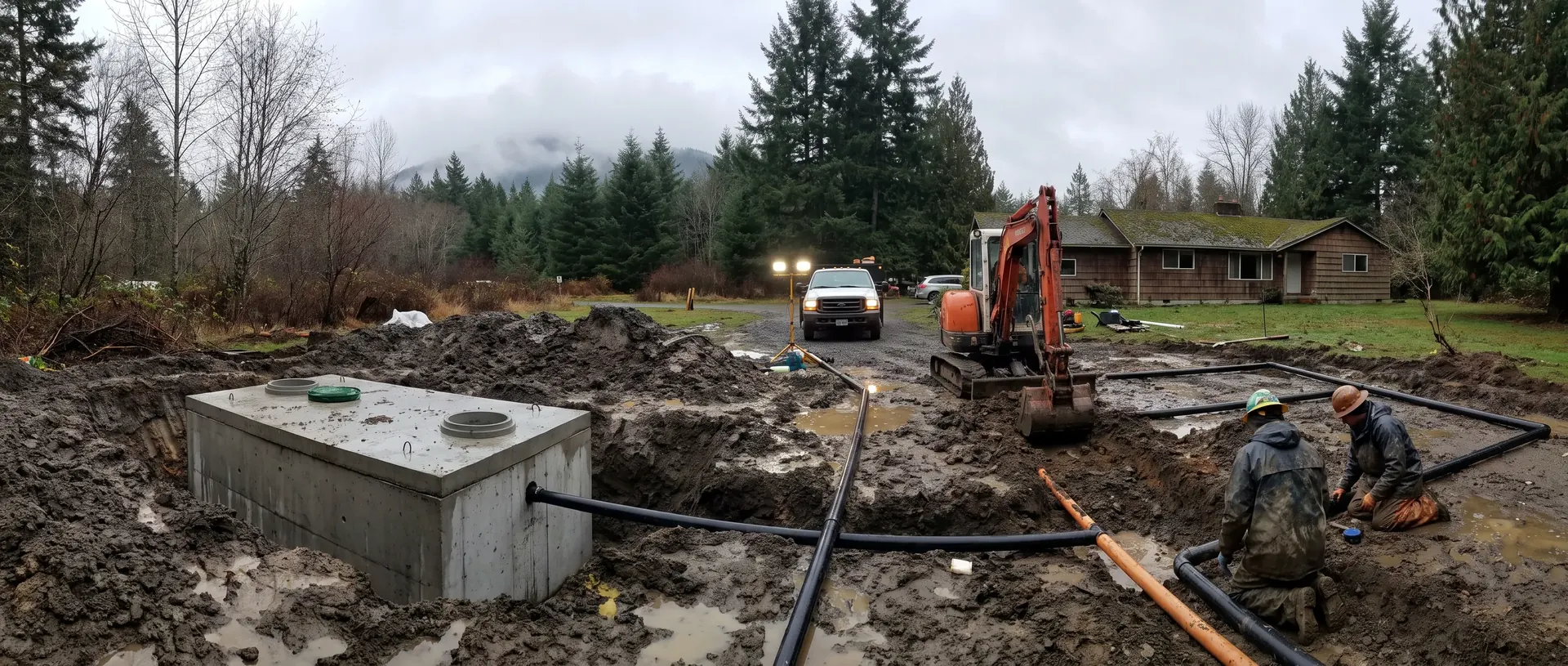
Septic System Installation in Whatcom County
Site evaluation, design, county permit and installation, handled as one job instead of three separate ones you have to coordinate.
- Site evaluation and soil work first
- Design and county permit package included
- Built for high winter groundwater
- Final inspection coordinated with the county
01The job
The soil decides the system, and the soil here varies enormously
A septic system is designed around what the ground will accept. That is the whole logic of it. Two properties a mile apart in this county can need completely different systems and completely different budgets, because one sits on free draining glacial material and the other sits on heavy clay with groundwater two feet down in February.
So the process starts with digging test pits and reading the soil profile, not with picking a tank.
What comes out of that determines whether you get a conventional gravity system, a pressure distribution system, a sand filter, a mound, or something else. It also determines how much land the drain field needs and where on the lot it can go, which occasionally changes where the house can go.
Doing that work properly at the start is the difference between a system that lasts thirty years and one that is in trouble in eight. In wet ground there is very little margin for a design that was optimistic about drainage.
02Scope
What we handle
New build systems
A complete system for a property with no existing septic. Site evaluation, design, permit, installation and final inspection.
Replacement systems
A new system where an old one has reached the end. Same process, plus decommissioning the old tank and working around existing buildings, wells, drives and landscaping.
Alternative and engineered systems
Where the soil or the site will not take a conventional gravity system: pressure distribution, sand filters and mound systems. These cost more and are frequently the only option on tight or wet lots.
03Included
What is included
Site evaluation
Test pits dug, soil profile read and logged, groundwater assessed, and the usable area of the lot established with setbacks from wells, water, buildings and property lines accounted for.
System design
A design matched to what the soil will actually accept and to the number of bedrooms the house has, drawn up for submission.
County permit package
Application, drawings and supporting documentation prepared and submitted, and the review process followed through.
Installation and final inspection
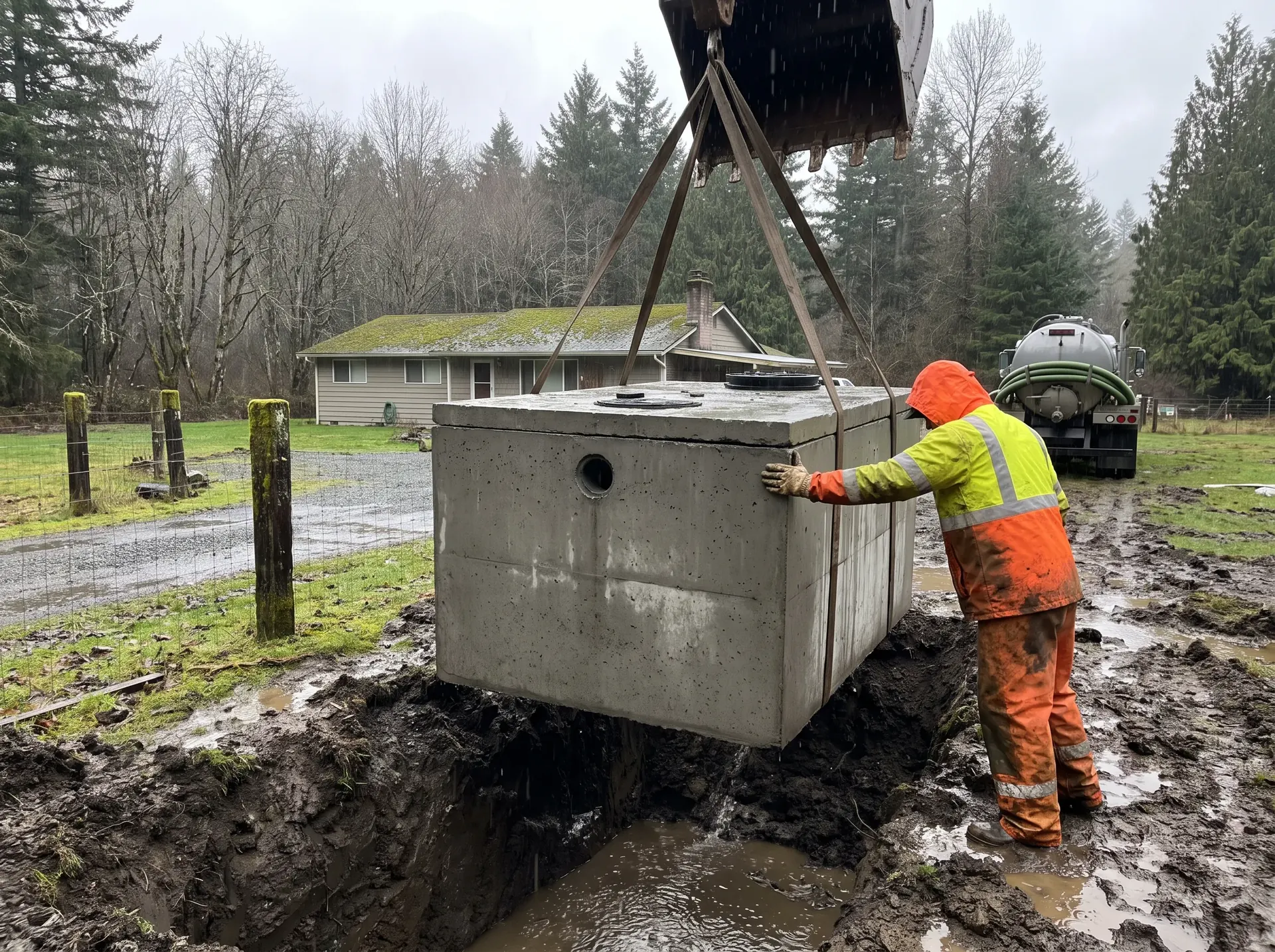
Excavation, tank set, trenches, pipe and drain rock, backfill and reinstatement, with the county inspection scheduled and attended.
04Job sequence
How an installation runs
Site visit
What is planned, how many bedrooms, where the well is, where the drive and buildings will sit, and what the ground looks like on the surface.
Site evaluation and soil testing
Test pits, soil logging and groundwater assessment. This determines everything downstream and it cannot be skipped or estimated.
Design
The system type, size and layout that the soil and the bedroom count require, drawn for submission.
Permit
Submitted to the county and followed through review. Timelines here are outside our control and we will be straight with you about that.
Installation
Excavation, tank, trenches, pipe, rock, backfill and reinstatement. Weather dependent in winter, and we will tell you honestly if a job should wait.
Final inspection and records
County inspection attended, and you get the as-built record for your own files. Keep it. Half our locating work exists because somebody did not.
05Why us
Why install with us
We do the evaluation, the design, the permit and the installation as one job. Splitting those across a designer, a contractor and the homeowner is the normal arrangement and it is where projects stall, because the gaps between them are nobody's responsibility.
We design for winter, not for the day we visited. A soil evaluation done in August tells you a great deal less about groundwater than one that accounts for what the site does in February. In this county that is a design input, not a footnote.
We are honest about permit timelines. They are what they are, they are not within our control, and building expectations around an optimistic version helps nobody.
And we hand you the as-built at the end and tell you to keep it somewhere findable. It is a five second piece of advice that saves the next owner a few hundred dollars and a lot of probing.
Dispatch
Planning a build or facing a replacement?
Start with the site evaluation. Everything else, including the budget, follows from what the soil says.
05Reviews
Placeholder review layout
Placeholder block. No customer reviews exist yet, so nothing here is real content and no rating, score or review schema is published. Replace with genuine reviews before launch or remove this section.
Placeholder quote B. This card exists to show the layout only. Replace this text with a real customer review before launch.
Placeholder quote C. This card exists to show the layout only. Replace this text with a real customer review before launch.
06FAQ
Septic installation questions
How much does a new septic system cost in Washington?
It swings widely with soil and system type. A conventional gravity system on good ground is the cheapest outcome and an engineered system on a difficult wet lot can be several times that. Our cost guide breaks down what drives it.
Can I install my own septic system in Washington state?
Installation is regulated and in practice this is not a homeowner job. The design, the permit and the inspection all sit within a county and state process, and an unpermitted system is a serious problem at resale as well as a health one.
How many bedrooms will a 1500 gallon septic tank support?
Tank size and drain field size are both set by bedroom count under the design rules, because bedrooms are used as the proxy for occupancy. The exact figures come from the applicable code rather than from a rule of thumb, and they are confirmed at design stage.
How long does it take to install a septic system?
The installation itself is usually a matter of days. The site evaluation, design and permit review beforehand are what set the real timeline, and those run to weeks or months depending on the county's workload.
What is a perc test?
A soil and percolation assessment that establishes how quickly the ground accepts water. It is the basis of the whole design. On difficult sites the result can rule out a conventional system entirely.
Do I need a new septic system if the drain field failed?
Not always. Sometimes only the field needs replacing and a sound tank can stay. Our drain field page covers how that gets decided.
07Coverage
Where we install
We install across Bellingham, Lynden, Ferndale, Blaine, Birch Bay, Everson, Nooksack, Sumas, Deming, Custer, Sudden Valley and Point Roberts.
View service areas- Bellingham
- Lynden
- Ferndale
- Blaine
- Birch Bay
- Everson
- Nooksack
- Sumas
- Deming
- Custer
- Sudden Valley
- Point Roberts
09Contact
Book a site evaluation
Tell us about the property, how many bedrooms are planned, and whether this is a new build or a replacement.
Call(360) 555-0147Mon to Fri, 7am to 5pm, with emergency service outside those hours.
- Same day emergency response
- The tank gets inspected while the lid is off
- Written reports the county and escrow accept
- No call out fee on a booked job
Request logged
Thanks. We will give you a time and a price.
If it is an emergency, call rather than waiting for a reply.
(360) 555-0147